by Dr. Ross Porter | May 11, 2020 | Blog
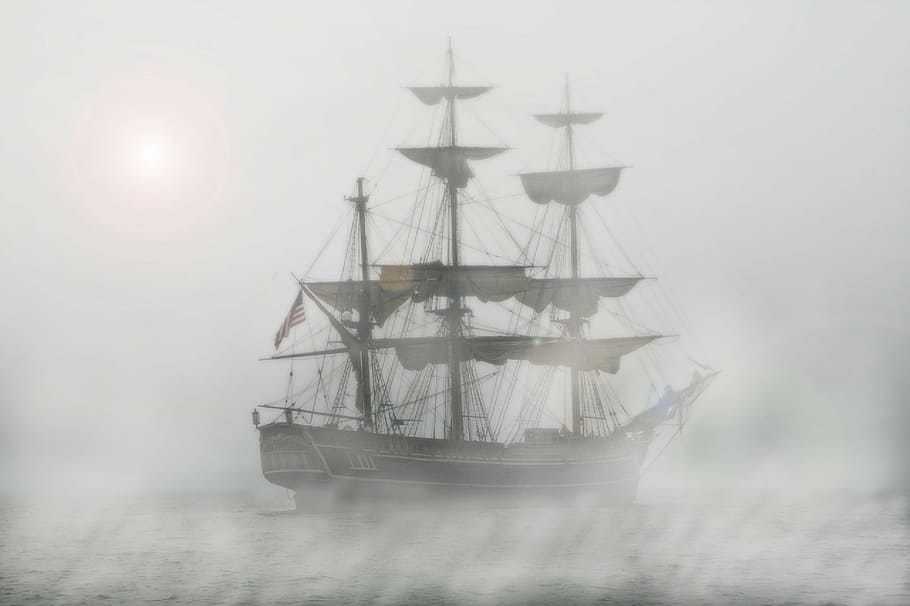
Robert Smalls was born into slavery in Beaufort, South Carolina. And at age 12, his master hired him out to business associates in Charleston where Smalls worked in a hotel, and later as a lamplighter. But his real love was the sea, so he found a way to work on the docks, then as a rigger and a sail maker, and eventually as a wheelman (basically a pilot, although slaves were not allowed to hold that title).Although a slave, when the Civil War began Smalls was assigned to serve on the CSS Planter, a lightly armed Confederate transport.
And on May 12, 1862, the three white officers of the Planter decided to spend the night on shore. Smalls, and seven other enslaved sailors, decided to steal the ship and sail it to freedom. So, dressed in the Captain’s uniform that included a straw hat, he sailed out of the harbor, and then stopped at a nearby wharf to pick up his wife, children, and the families of the other crewman who were hiding there. Having learned the secret Confederate codes and signals, Smalls, sailed the Planter past five different Confederate forts that guarded the harbor without ever being stopped.
And by morning, flying a white bedsheet as a sign of surrender to avoid being fired upon by Union ships, Smalls was home free. He turned the ship over to the United States Navy, along with the valuable cargo that included canons, artillery pieces and ammunitions earmarked for Confederate forts, and the secret Confederate signal book.For his exploits, Smalls was celebrated in Union newspapers and was invited to a private meeting with President Lincoln. There, he was able to persuade the President to allow African-American men to serve in the Union Army as soldiers. When Lincoln agreed, Smalls joined the Army.
He was later transferred to the Navy where he would be named the first black captain of a vessel---ironically the same one he’d commandeered two years before, the Planter, now a ship in the Union Navy. By the end of the War, he had been involved in 17 different battles.Now if he did nothing else for the rest of his life, Robert Smalls would be a hero. But there was more.After the war, Smalls returned to Beaufort and purchased the home he’d been a slave in. And in an amazing act of charity, he allowed the aged widow of his former slave master to live there with him and his family until her death.Smalls would go on to become a successful businessman, opening a store where former slaves could work, and was elected to the South Carolina State House of Representatives and State Senate, and finally the United States House of Representatives where he would serve for five terms.
This legend of a man would die at 75 years-old in the same town he was born in as a slave. But because of his life Beaufort, South Carolina, and indeed America, had become a very different place.
Robert Smalls is a hero you should know. And I’m Dr. Ross Porter.

by Dr. Ross Porter | May 11, 2020 | Blog
Alaska Airline flight attendant Shelia Fedrick didn’t board the plane that fateful day in 2011 thinking she’d become a hero. But soon after the flight from Seattle to San Francisco took off, Fedrick noticed the young girl with dishevelled clothing and greasy-blonde hair. She looked like she’d been through hell. Next to her was a well-dressed, much older man. Fedrick’s instincts told her something was wrong, so she attempted to strike up a conversation with the two. The girl remained silent while the man became defensive. At that point, Fedrick devised a plan.She went to the bathroom and pasted a note for the girl on the mirror. Fedrick then returned to aisle 10 and whispered to the teen—whom she guessed was around 14 years-old—to visit the bathroom. Once there, the girl found the note asking if she needed help. The girl wrote on the note that she did.Fedrick then notified the pilot, who quickly contacted law enforcement officers in San Francisco. They were waiting for the man at the terminal when the flight landed. He was questioned, taken into custody, and arrested. And the fourteen year-old was saved from sex slavery.Nine years later, Fedrick and the girl she rescued—now a college student—are still in touch.The International Labor Organization estimates that there are currently 4.5 million people trapped in the sexual slavery worldwide. In 2016 2,000 people were arrested for human trafficking by U.S. Immigration and Customs Enforcement, and 400 victims were freed.Airline Ambassadors International, an organization that teaches flight attendants to look for signs of sex trafficking and provides training on intervention, is doing its best to ensure that there are more Shelia Fedricks in the not-always-friendly skies. To date over 1,000 flight attendants have received this special training.All angels fly. And at least one wears a uniform.Shelia Fedrick is a hero you should know. And I’m Dr. Ross Porter.

by Dr. Ross Porter | May 11, 2020 | Blog
In the months following the bombing of Pearl Harbor, President Franklin Roosevelt authorized the involuntary internment of more than 110,000 men, women and children of Japanese heritage. Most Americans considered this a necessary measure to protect the United Sates from further attacks. But 16 year-old Ralph Lazo was not one of them. Lazo watched as his Japanese-American friends began to be shipped to Manzanar—the relocation site nearest his home. And as summer vacation arrived, the young man decided he had to act. Telling his family he was going to ‘camp’, Lazo boarded a train with his neighbors and headed to the dusty and crowded one square mile fenced facility, complete with barbed wire, armed guards and guard towers, and searchlights. And there he stayed for two and a half years, after his family tried and failed to talk him into coming home. The guards and families at Manzanar had just assumed that he was part-Japanese. While there, Ralph worked the grounds, delivered mail, and graduated from Manzanar High School, where he was elected student body president, even though he finished at the bottom of his class of 150. He remains the only non-spouse, non-Japanese to voluntarily relocate to Manzanar. The government only realized Ralph didn’t belong after he registered with the Draft Board. He entered the United States Army in August of 1944, and served in the Philippines, where he received a Bronze Star for bravery in combat. After the War, Ralph was a teacher, a mentor of disabled students and young adults, and helped raise funds for the class action law suit that won reparations for the interned Japanese-Americans. Ralph Lazo is a hero you should know. And I’m Dr. Ross Porter.
by Dr. Ross Porter | Jun 6, 2018 | Blog
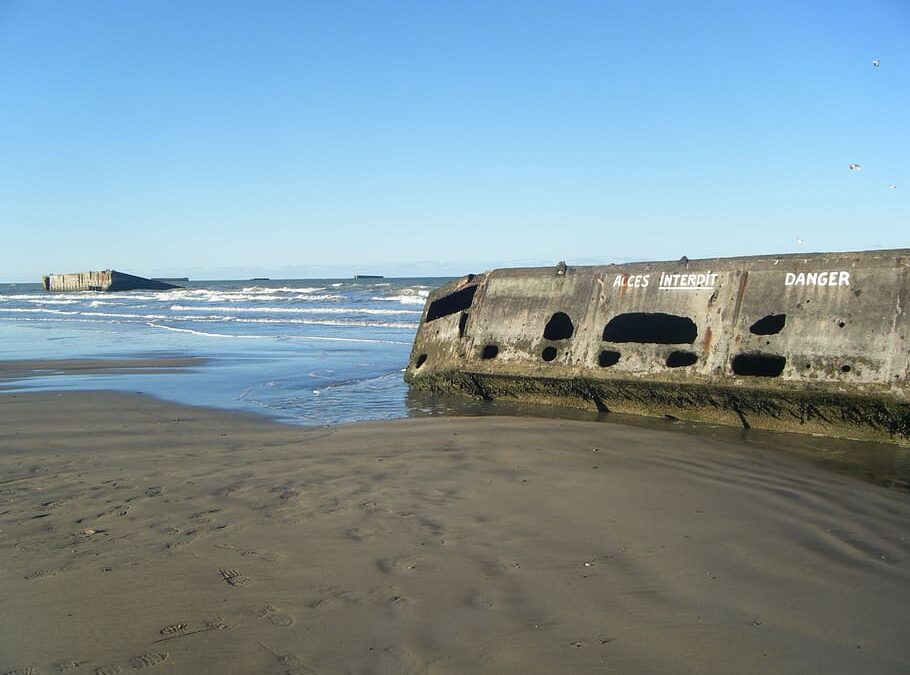
74 years ago today, more than 160,000 Allied soldiers stormed 50 miles of Normandy coastline, to strike a decisive blow for freedom. 60% of those men were killed or injured before they even reached the shore, and 10,000 would not live to see nightfall on June 6th—D-Day.A few years ago, Jenni and I travelled to Normandy, and arrived in the small town of Bayeux late in the afternoon. And because we were still a couple of hours away from dinner time, we decided to dump the suitcases in our room and set out on a walk. Almost immediately we came upon a sign pointing toward the British war cemetery on the outskirts of town, and we decided to pay our respects. There, just under 4,000 British soldiers are buried, having paid the ultimate price for freedom in the historic invasion. Making our way slowly and reverentially through the rows of tombstones we noticed a still-fresh bouquet of flowers lying on the grave of a twenty year old British soldier who had died the day of the invasion. And as we drew closer, I saw a notecard peeking out from beneath the flowers, with the slightly smudged “17 June” visible. The visitor had been there just a day before we arrived. Who would be leaving a handwritten message on a marker that was 64 years-old? My curiosity got the best of me and I gently lifted the bouquet to read the rest of the message.“Sweetheart, I love you and always will.” Even now as I read these words I catch my breath; the message was so simple, and so profound. Of course there is much we don’t know about this love. But we do know what matters most…that it endured. Across the years and tears, the love endured. But how? How much time could these sweethearts have even had together? He was dead, tragically taken, before his twenty-first birthday. Yet, sixty-four years later she returned; still feeling, remembering, and sharing what they had. Reality is so much more powerful than anything Hollywood could dream up. I think about that woman every time June 6th roles around. So many lives altered on that one significant day. And how different would our lives be today if the Nazi’s had repelled the Allied forces, and turned the tide of the war? What if evil had won? The ‘greatest generation’ is almost gone, now, and as they slip into eternity I fear that fewer and fewer will fully appreciate the tremendous debt of gratitude owed to these heroes. This is why days like today are so significant. We must be reminded to remember.And ‘remembrance’ becomes a virtue when we both remember and then live differently, more gratefully and purposefully, because of the remembering…we honor those who sacrificed for the Good, and remind ourselves that freedom isn’t free…and that “freedom consists not in doing what we like, but in having the right to do what we ought.”May we never forget what happened on the beaches of Normandy on this day. And the responsibility we carry to live differently because of this day!
by Dr. Ross Porter | Apr 2, 2018 | Blog
Stetson Kennedy was a man of the South—a white man, from a well-to-do family, and a descendant of plantation-owning signers of the Declaration of Independence and Confederate officers. He could have easily hid snuggly in his comfort zone, and avoided the pressing racial issues that festered all around him. But that’s not what he chose to do.His parents expected him to work in the larger community of Jacksonville, Florida. So, from an early age Kennedy went door to door, collecting payments for his father’s furniture store. And this exposure opened his eyes—to the suffering of whites and blacks alike. And as heroes do, he decided he’d do something about the injustice he witnessed.So he wrote. And by age 21 he was put in charge of the Florida Writer’s Project collecting folklore, ethnic studies, and oral histories of the state. He was also given the responsibility of supervising the work of fellow writer and African America Zora Neal Hurston. Watching her endure the hate that was so often spewed at her only deepened his empathy.In 1942 Kennedy gained a larger platform, becoming the Southeastern Editorial Director of the Congress of Industrial Organizations (the CIO). He investigated and wrote articles on discriminatory activities undermining democracy in the United States, but simply writing about injustice proved unsatisfactory.Unable to fight racial hatred overseas during World War II because of a back injury, Kennedy decided to go to war at home against what he called “homegrown racial terrorists”—and he chose the Ku Klux Klan as his opponent. He used the name of a deceased uncle, who had been a member of the Klan, to gain the trust of local Klansmen and joined their ranks as an “encyclopedia salesman.” As a folklorist he had a natural understanding of ritual and quickly learned the secret code words of the Klan, as well as the Klan’s chain of command and its plans for violence, which he was able to share with Federal law enforcement, the Anti-defamation League, and The Washington Post.He even leaked information about the Klan to the producers of the popular Superman radio program, who used the information in a story line titled, “Clan of the Fiery Cross.”And with evidence he found in the wastebasket of the Klan’s grand dragon, Kennedy eventually helped the Internal Revenue Service file a tax lien against the Klan in 1944 of $685,000 ($9,481,139 in today’s dollars!).Stetson would also testify against Klan members in Federal Court, in cases involving bombings and violence aimed at suppressing Black voter turnout. Finally, he helped draft the brief used by the state of Georgia to revoke the Klan’s national corporate charter in 1947. One would be hard-pressed to find an individual who did more to de-fang the Ku Klux Klan.Stetson Kennedy is a hero you should know. And I’m Dr. Ross Porter.